Learning System Design #13: To RAG or not to RAG
Part #13 of the “Learning System Design” series! This time — RAG, Retrieval-Augmented Generation. The three letters everyone drops into every AI architecture diagram, usually right next to a vector database nobody in the room can quite explain the need for. I kept nodding along in those meetings until I actually sat down and built the thing — and it turns out RAG is far less mysterious, and far more of a plain old search problem, than the hype makes it sound.
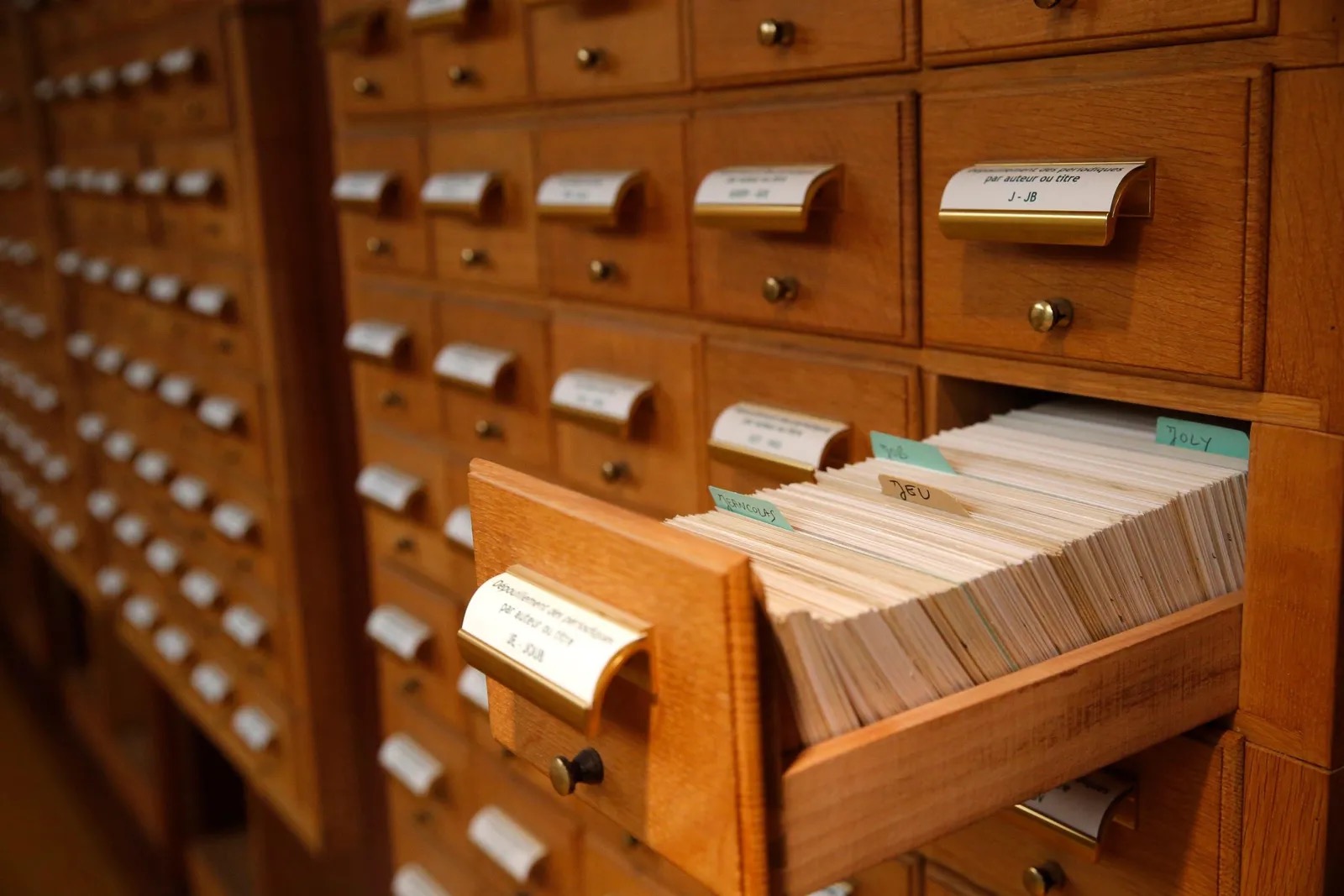
The mental model I keep coming back to is an open-book exam. A fine-tuned model is the student who crammed everything into their head and walks in with nothing — fast, but frozen on the day they stopped studying. RAG is the student who walks in with the textbook and, for every question, flips to the right page first and answers from it. Same brain, wildly different answers — because one of them gets to look things up.
What RAG actually is
An LLM only knows two things: what was in its training data, and what you put in the prompt right now. The weights are frozen the day training stops — they don’t know your codebase, last week’s incident, or anything private.
RAG is the embarrassingly simple pattern of fetching the relevant bits at question time and pasting them into the prompt, so the model answers from your data instead of its frozen memory. That’s the whole idea. Everything else — embeddings, vector DBs, rerankers — is just machinery in service of doing that fetch well.
And that reframes the entire problem. It’s the one thing I want you to walk away with: RAG is a search problem wearing an LLM costume. The LLM part is mostly solved — you call an API or run a local model. The part that decides whether your answers are gold or garbage is the retrieval. Feed the wrong chunks into the prompt and the smartest model on earth will confidently answer from the wrong context.
The pipeline
It splits cleanly into two phases: build the index once, then answer queries against it forever.

Indexing (offline):
- Chunk your documents into passages — a paragraph, a section, a few hundred tokens. Too big and you drown the prompt in noise; too small and you slice a thought in half.
- Embed each chunk with an embedding model. An embedding is just a vector — a list of ~768 to 1500 floats that captures the meaning of the text. Similar meaning → vectors that sit close together.
- Store those vectors in a vector database so you can search them fast.
Querying (online):
- Embed the question with the same model.
- Search for the nearest chunk vectors — a nearest-neighbour lookup: “find the k passages whose meaning is closest to this question.”
- Rerank the top candidates (optional, but worth it — more below).
- Build the prompt:
question + retrieved chunks + "answer using only this context". - Generate — the LLM writes a grounded answer, ideally with citations back to the chunks.
If you’re a backend dev, the retrieval step is less exotic than it sounds. With pgvector it’s a plain SQL query against Postgres:
SELECT id, content
FROM chunks
ORDER BY embedding <=> $1   -- $1 = the query's embedding vector
LIMIT 5;
That <=> is cosine distance. No magic here — it’s ORDER BY ... LIMIT, just over vectors instead of numbers. Then you stitch the results into the prompt:
context = "\n\n".join(c.content for c in top_chunks)
prompt = f"""Answer using ONLY the context below. Cite chunk ids.

Context:
{context}

Question: {question}"""
answer = llm.generate(prompt)
That’s a working RAG system. Everything past this point is just making each step better.
To RAG or not to RAG
Here’s the part people skip: RAG is one option among four, not the default. When you want a model to “know” something it doesn’t, you actually have a menu:
| Approach | What it does | Best when | Weakness |
|---|---|---|---|
| RAG | Retrieve context at query time | Data changes, must be private, needs citations | Answer quality capped by retrieval quality |
| Fine-tuning | Bake knowledge/behaviour into the weights | Fixed style, format, or narrow skill | Stale the day your data changes; costly to redo |
| Long context | Paste everything into one huge prompt | The whole corpus fits the window, one-off | Cost & latency scale with tokens; “lost in the middle” |
| Agent / tools | Model calls live APIs and databases | Structured, transactional data or actions | Needs good tools; useless for fuzzy recall |
The decision usually comes down to a few honest questions:
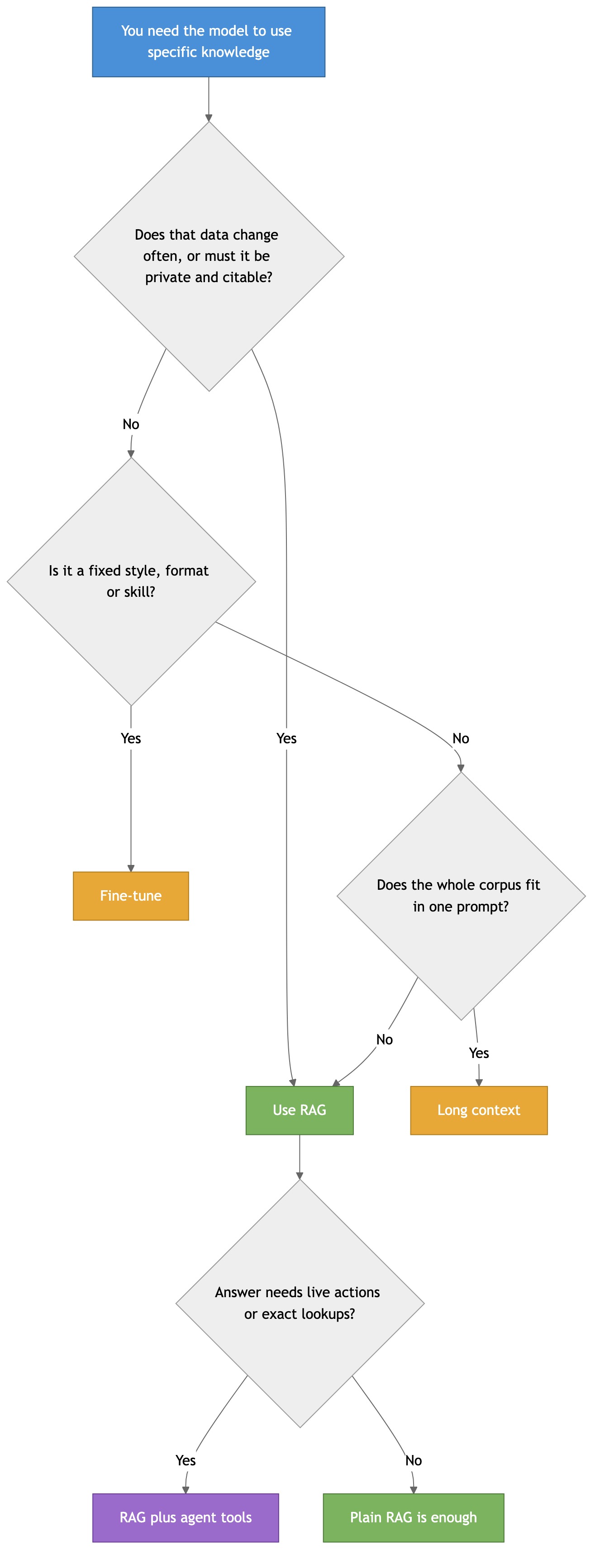
The rule of thumb I use: does the knowledge change, and does it need to be private and citable? If yes → RAG. If you’re teaching a fixed style or skill rather than facts — “always answer in this JSON shape”, “write in our brand voice” — that’s fine-tuning, not RAG. If the whole thing genuinely fits in one prompt and you’ll ask it once, just paste it in; don’t stand up a vector DB for a one-off.
And these aren’t mutually exclusive. Real systems fine-tune a small reranker, keep a long-context model for the final synthesis, and let an agent decide when to retrieve. RAG is the backbone, not the whole skeleton.
Where the quality actually lives
Because RAG is a search problem, the wins are all in retrieval. Three levers, in the order they’ll bite you:
Chunking. The most underrated knob. Split on natural boundaries (headings, paragraphs), keep a little overlap so a thought isn’t guillotined between two chunks, and attach metadata (source, section, date) you can filter on later. Bad chunking is the #1 reason a RAG demo dazzles and the same system flops in production.
Hybrid search. Pure vector search is great at meaning but bad at exact tokens — product codes, error strings, names. Keyword search (BM25) is the exact opposite. Run both, merge the results, and you catch what either alone misses. Almost every serious system is hybrid.
Reranking. Vector search is fast but approximate — it hands you 50 “probably relevant” chunks. A reranker is a smaller, slower, more accurate model that reads the query against each candidate and re-scores them, so the actually best 5 float to the top of the prompt. It’s the cheapest single upgrade to answer quality I know of.
There’s a whole zoo beyond this — query rewriting, HyDE, Graph RAG for relationship-heavy questions, multimodal RAG for images and audio — but 90% of your quality comes from chunking well, searching hybrid, and reranking.
You can run the whole thing yourself
One thing I genuinely like about RAG: none of it forces you onto someone’s SaaS. The embedding model, the vector DB, the reranker, even the generator LLM all have solid open-source options you can docker run on your own box — pgvector or Qdrant for vectors, a local embedding model, Ollama for the LLM. People are running trimmed RAG stacks on a Raspberry Pi or a Jetson Nano. If owning your data is the reason you reached for RAG in the first place, you can own the entire pipeline end to end.
When you should NOT reach for RAG
RAG is a trade, not a free upgrade. Skip it when:
- The corpus is tiny and static. Ten pages that never change? Paste them into the prompt. A vector DB is pure overhead.
- You need a fixed behaviour, not facts. “Always output this format” is fine-tuning’s job.
- The data is structured and transactional. “What’s this customer’s balance?” is a SQL query or a tool call, not semantic recall. Don’t fuzzy-search a number you can look up exactly.
- Latency is sacred. Every RAG query is embed → search → (rerank) → generate. That’s more moving parts, and more milliseconds, than a single model call.
The failure mode I see most: teams bolt a vector DB onto a problem that was a plain database query all along, then wonder why it’s slow and occasionally wrong.
Summary
- RAG = fetch relevant context at query time and put it in the prompt, so the model answers from your data, not its frozen weights.
- Mental model: an open-book exam — same brain, but it gets to look things up.
- The pipeline is index once (chunk → embed → store) then query forever (embed → search → rerank → generate).
- RAG is a search problem — retrieval quality caps answer quality, so chunking, hybrid search, and reranking are where the real wins are.
- It’s one of four options — RAG vs fine-tuning vs long context vs agents — pick by whether the knowledge changes and must be private/citable.
- You can self-host the entire stack, down to a Raspberry Pi.
- Don’t RAG a tiny static corpus, a fixed-format task, or an exact lookup.
I wrote this up as a full, hands-on guide — the pipeline in depth, the model zoo, vector DBs, Graph RAG, multimodal, memory, and edge deployment, all self-hosted-first:
https://github.com/sadensmol/learning_system-design/blob/main/rag-guide/README.md
If you want to go deeper on a specific piece, the chapters stand alone:
Foundations — the pipeline in detail:
https://github.com/sadensmol/learning_system-design/blob/main/rag-guide/01-foundations.md
Types of RAG — naive → agentic, HyDE, rerankers, corrective RAG:
https://github.com/sadensmol/learning_system-design/blob/main/rag-guide/02-evolution-and-types.md
Vector databases — FAISS, Qdrant, pgvector, sqlite-vec, HNSW/IVF:
https://github.com/sadensmol/learning_system-design/blob/main/rag-guide/05-vector-databases.md
Graph RAG — when relationships beat plain vectors:
https://github.com/sadensmol/learning_system-design/blob/main/rag-guide/07-graph-rag.md
Edge devices — running RAG on a Raspberry Pi / Jetson:
https://github.com/sadensmol/learning_system-design/blob/main/rag-guide/09-edge-devices.md
Thanks for reading! More system design topics coming in the next parts of the series.
PS: what’s your retrieval stack — plain pgvector, a dedicated vector DB, hybrid + rerank, or did you skip RAG entirely and just throw a bigger context window at it? I’d love to hear what actually worked in production.